How do I choose between TU-affiliated engineering colleges?
Because Tribhuvan University sets the curriculum, the examinations and the degree, those three are identical everywhere. What differs is cost, commute, teaching, laboratories and whether hostel or transport exists at all.
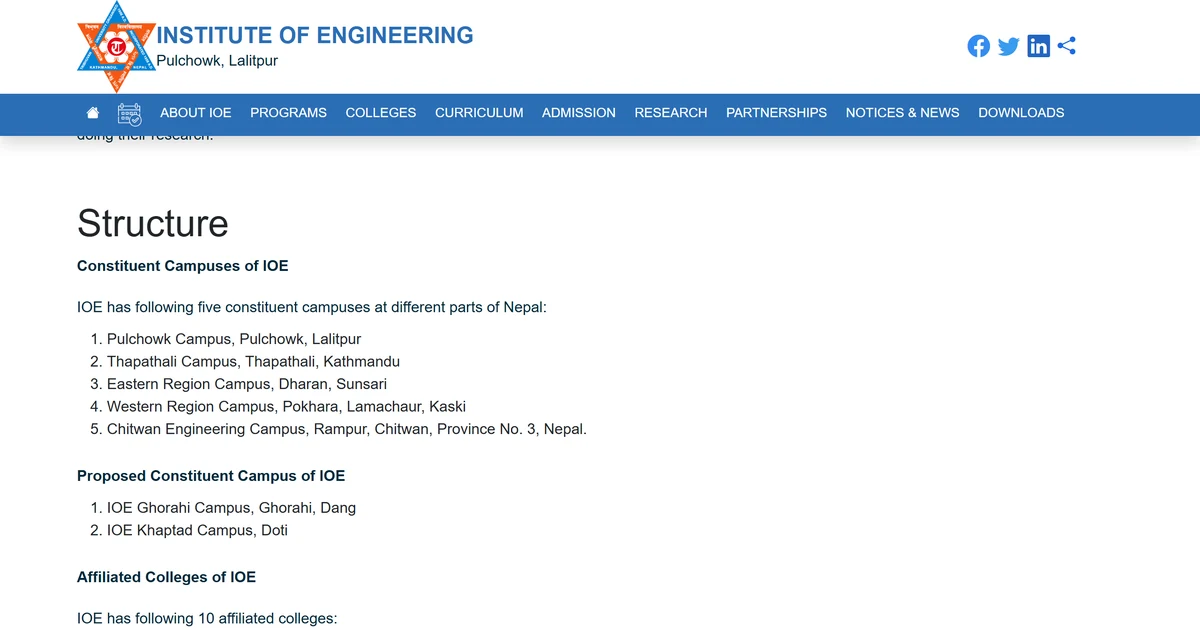
Tribhuvan University awards the degree, sets the curriculum and runs the examinations at all fifteen providers under the Institute of Engineering, so the degree, the syllabus and the papers are identical whichever you choose, and no college can offer you a better one. That narrows the decision to five things a prospectus usually buries: the total cost across four years including deposits and what is refundable, the commute done once on an ordinary morning, how many students sit in a section and who teaches the core papers, the laboratories seen on a working day rather than described, and whether hostel and mess exist and what they cost. Two facts change how you read the shortlist. The only comparable figure IOE publishes for the private sector is the intake target, because affiliated fees are not published centrally. And no affiliated college has a closing rank, because it admits any candidate on the published pass list.
That sounds like it makes the choice harder. It makes it much easier, because it moves every question onto ground you can actually check.
Cost across four years, not the first instalment. Ask for the total, in writing, including deposits, and ask separately what is refundable and when. The refund ladder tightens fast and stops entirely a week after classes begin.
The commute, done once, on an ordinary morning. No college in the system is obliged to transport you, and no published fee table includes it. Make the journey yourself before you commit four years to it.
Who actually teaches, and how full the room is. Intake target is published; the teaching that serves it is not. Ask how many students are in a section and who takes the core papers.
Laboratories, seen rather than described. For Civil, Computer and Electronics the lab is most of the difference between two colleges with the same syllabus. Ask to walk through them on a working day rather than during an open house.
Whether hostel and mess exist, what they cost, and whether food is billed separately from the bed. These sit above the fee baseline rather than inside it, so they are a genuine point of difference and are easy to forget when comparing headline numbers.
First check the programme is taught there at all
The booklet publishes each college’s intake broken down by programme, and for three of the five programmes it shortens the list before you compare anything else. Civil and Computer run at all ten affiliated colleges. Electronics, Communication and Information runs at eight. Electrical runs at four. Architecture runs at two. A shortlist of five colleges for a student who wants Electrical is really a shortlist of one or two, and that is worth establishing before you spend a Saturday visiting.
The one comparable figure IOE publishes
Fees at affiliated colleges are not published centrally — the booklet prints them only for the constituent campuses — so the single comparable number IOE gives you for the private sector is the intake target. It is worth having, because it tells you the scale of the place and, through the 10% rule, roughly how many subsidised places exist there.
| College | District | Intake | Seats at IOE Regular rate |
|---|---|---|---|
| Kathmandu Engineering College | Kathmandu | 384 | 38 |
| Advanced College of Engineering and Management | Kathmandu | 336 | 34 |
| Kantipur Engineering College | Lalitpur | 288 | 29 |
| Himalaya College of Engineering | Lalitpur | 240 | 24 |
| National College of Engineering | Lalitpur | 240 | 24 |
| Kathford International College of Engineering and Management | Lalitpur | 192 | 19 |
| Janakpur Engineering College — now Imperial College of Engineering | Bhaktapur | 192 | 19 |
| Khwopa College of Engineering | Bhaktapur | 192 | 19 |
| Sagarmatha Engineering College | Lalitpur | 144 | 14 |
| Lalitpur Engineering College | Lalitpur | 96 | 10 |
Scroll the table sideways for Intake and Seats at IOE Regular rate.
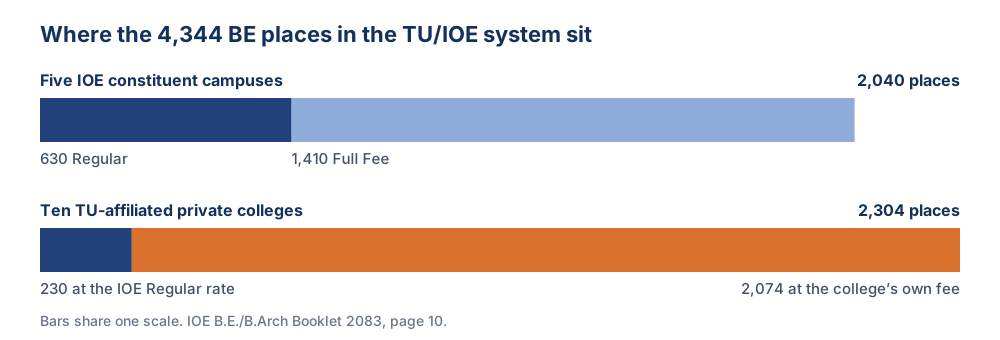
Six of the ten are in Lalitpur, two in Bhaktapur and two in Kathmandu, which for most applicants makes location the first filter rather than the last. The ten together target 2,304 places against 2,040 at the constituent campuses, and of those 2,040 only 630 are Regular seats, so the subsidised places everyone competes for are under a sixth of the system.
What a rank does and does not decide
A constituent campus closes at a rank because it runs out of seats, so there is a cut-off to compare yourself against. An affiliated college admits any candidate on the published pass list, so there is no closing rank at all. A rank that reaches no constituent campus is therefore not a rank that has run out of options — it is a rank that has run out of constituent options, which is a different sentence and the one most students are never told.
Two questions worth asking that nobody asks
First: how many students did you admit under the 10% provision last year, and how was a student selected for one? The obligation is real and applies to every college on that list, but the booklet does not say how the seats are allocated, so the answer varies and it is fair to ask for it. Second: what happens to my deposit if I cancel before classes start? The booklet is explicitly silent on the deposit in that window, so the answer is the college’s own policy and you want it in writing before you pay.
Intake figures and the per-programme breakdown read from the affiliated-college table on page 10 of the IOE B.E./B.Arch Booklet 2083, verified against a rendered image of that page because the booklet sets its Nepali in legacy fonts that do not survive copying; each column reconciles with its own printed total and the ten sum to the printed 2,304. Districts from section 2.6, page 9. Constituent-campus totals from the table on the same page 10. The 10% column is ten per cent of the printed intake — the booklet does not state how the figure is rounded, so it is arithmetic rather than a quota any college has confirmed. No fee appears against any of the ten because IOE does not publish affiliated fees centrally and the figure would have to come from each college’s own published page, with the date it was read; where that does not exist the cell stays empty rather than being estimated. No rating or ranking of any college appears here at all.
At Imperial College of Engineering
Imperial College of Engineering is the Bhaktapur entry at 192, and it is on that list on the same terms as the other nine.
Sources
- IOE B.E./B.Arch Booklet 2083published 7 August 2026 · read 31 August 2026
- IOE at a glance, Tribhuvan Universityread 31 August 2026
Last reviewed by Ram Raj Thapa, Admissions Officer, Imperial College of Engineering. Every figure on this page is cited to the document it came from.